

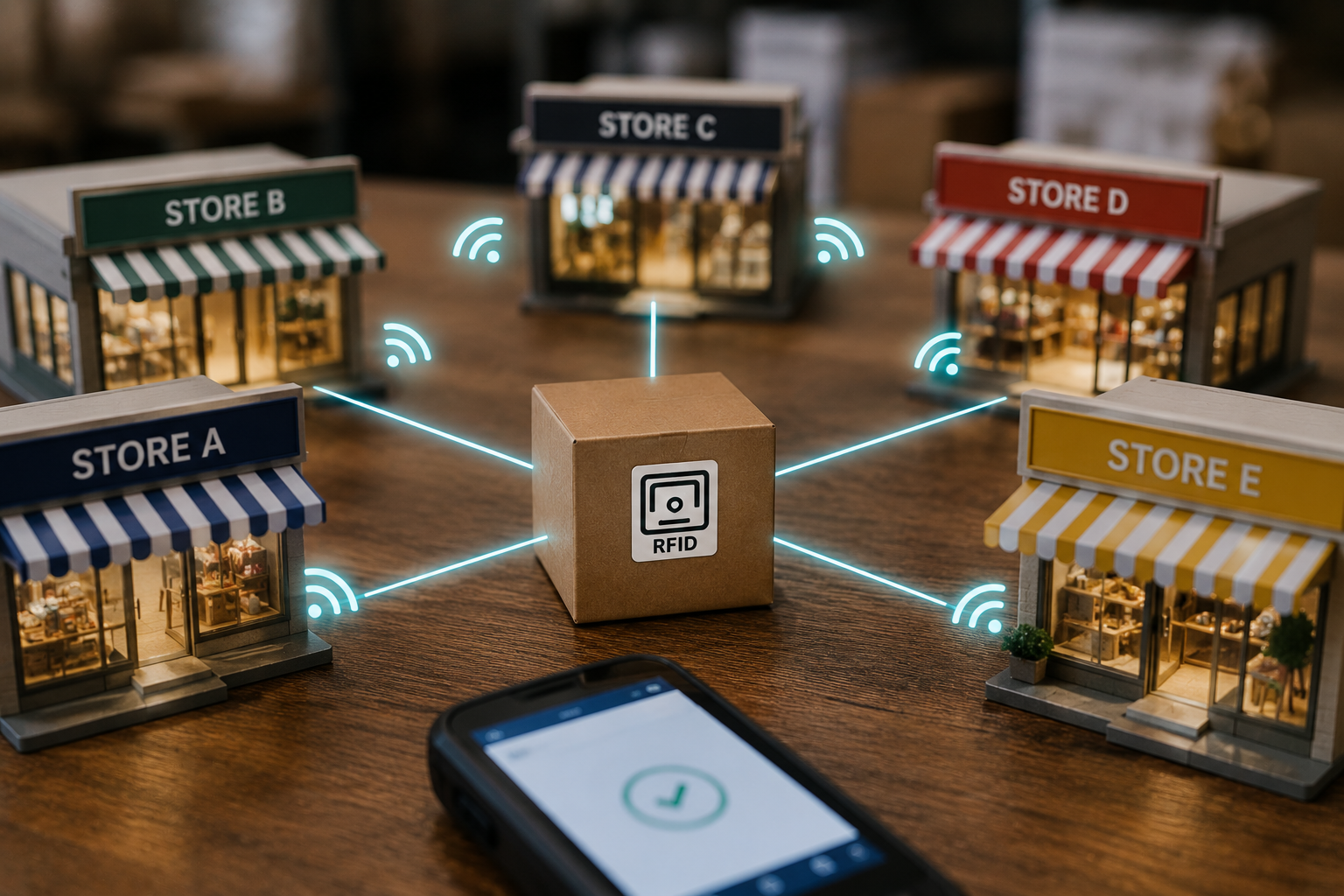
Store A Needs More Stock, While Store B Has the Same Product Available
A popular product is selling quickly at one store and approaching its replenishment threshold. At another location, the same SKU still has several units available. For a Retail Operations Manager overseeing dozens of stores, knowing this information at the right time can influence whether the next decision is to replenish from a distribution center, transfer inventory between stores, or maintain the current allocation.
This is where multi-store inventory visibility becomes important. Retail teams need a current view of what is available at each location so they can coordinate product availability with actual demand across the network.
The larger the retail network becomes, the more useful this visibility is for Store Directors, inventory teams, merchandising teams, and central operations.
A Single Stock Number Does Not Tell the Whole Story
For multi-location retailers, knowing total inventory across the business provides only one part of the picture. Managers also need to understand where that inventory is located and its current operational status.
For example, 500 units of one SKU across a retail network could be distributed very differently:
|
Location
|
Available Units
|
|
Store A
|
18
|
|
Store B
|
72
|
|
Store C
|
35
|
|
Store D
|
110
|
|
Distribution Center
|
265
|
The company has 500 units in total, but each location has a different inventory position. Store A may require replenishment soon, while Store D may have enough stock to support its current demand.
Location-level information gives retail teams a stronger basis for deciding how inventory should move across the network.
What Retail Managers Need to See Across Locations
Useful inventory visibility should help managers understand both the current stock position and how products move over time.
Depending on the retail operation, teams may need to monitor:
- SKU and product identification
- Current inventory by store
- Stockroom and sales floor availability
- Inventory at distribution centers
- Goods received at each location
- Inter-store stock transfers
- Product movement history
- Replenishment status
- Inventory counts and verification results
- Sales and inventory trends by location
The appropriate level of detail depends on how the retailer manages its inventory. A fashion retailer tracking individual garments, for example, may require a different tagging strategy from a business that manages products primarily at carton or case level.
Turn Inventory Visibility into Better Allocation Decisions
The value of multi-store inventory data becomes clearer when teams use it to guide everyday decisions.
Suppose Store A is experiencing strong demand for a particular product while Store B has more available inventory relative to its current sales pattern. With a current view of both locations, the operations team can evaluate an inter-store transfer alongside its standard replenishment plan.
A practical inventory management process can therefore connect several activities:
- Monitor inventory availability by store and SKU.
- Review sales or consumption patterns by location.
- Identify stores approaching their replenishment thresholds.
- Check inventory available elsewhere in the retail network.
- Determine the appropriate replenishment or transfer action.
- Record product movement between locations.
- Review subsequent inventory levels to confirm the new stock position.
This creates a more measurable approach to inventory allocation because decisions are connected to current stock information and actual store requirements.
Stockouts and Overstock Are Both Inventory Allocation Signals
A stockout can indicate strong demand, timing between replenishment cycles, or an inventory allocation that needs adjustment. Higher-than-needed stock at another location can provide another useful signal about product distribution.
Rather than looking at either condition in isolation, retail managers can review the broader network.
For example, useful questions include:
- Which SKUs are approaching minimum stock levels?
- Which stores have sufficient inventory for expected demand?
- Where are specific products selling most frequently?
- Which locations may benefit from stock redistribution?
- How frequently are inter-store transfers occurring?
- Does recorded inventory align with verified inventory at each location?
- Which products require more frequent replenishment?
These questions turn inventory visibility into an operational planning tool rather than simply a stock count.
Where RFID Fits into Multi-Store Inventory Management
Once retailers have defined which products, locations, and inventory movements they need to monitor, RFID can make identification and verification more efficient.
Each tagged product or inventory unit carries an RFID identity. Compatible RFID readers can capture tag information within their configured reading environment, allowing inventory data to be recorded as products are received, verified, moved, or counted.
An RFID Retail Management Solution can support activities such as:
- RFID-based product identification
- Inventory verification by store
- Stock visibility across multiple locations
- Receiving and transfer records
- Inventory movement tracking
- Stock count support
- Location-based inventory reporting
- Centralized retail inventory dashboards
The specific capabilities depend on the RFID architecture, tagging level, reader placement, store environment, and integration with the retailer's inventory systems.
A Central Dashboard Gives Operations Teams the Network View
RFID data becomes particularly useful for multi-store operations when information from individual locations is brought into a centralized inventory view.
A Store Director can focus on inventory within a specific branch, while a Retail Operations Manager can review availability across the broader network. The same underlying inventory information can therefore support decisions at different operational levels.
For example, a central dashboard could allow managers to filter inventory by SKU, store, region, stock status, or product category. This makes it easier to identify locations that need attention without reviewing every store individually.
Historical information can add another layer of context by showing how inventory has moved between locations and how stock positions change over time.
Building Inventory Visibility That Scales with the Store Network
As retailers add stores, SKUs, and distribution points, inventory visibility needs to scale with the operation. Clear product identification, location-level stock records, structured transfer processes, and consistent inventory verification provide the foundation for understanding where merchandise is available across the network.
RFID can strengthen that foundation by connecting tagged inventory with store-level identification, movement records, and centralized reporting. With an appropriately designed RFID Retail Management Solution, Retail Operations Managers and Store Directors can use inventory information to support replenishment, stock allocation, and product availability decisions across multiple locations with greater clarity.