

Turning Machine Data into Better Production Performance
Manufacturing operations rely on machines that work together to maintain production targets, quality standards, and delivery schedules. Every machine generates valuable information throughout its operating cycle, from production output and operating time to downtime events and performance conditions.
For Manufacturing Directors and Production Managers, connecting this information through an Industrial IoT Platform creates a clearer view of how production equipment performs throughout the day.
With real-time machine data, teams can monitor operational performance more consistently, identify improvement opportunities, and make production decisions based on measurable information.
Understanding Overall Equipment Effectiveness (OEE)
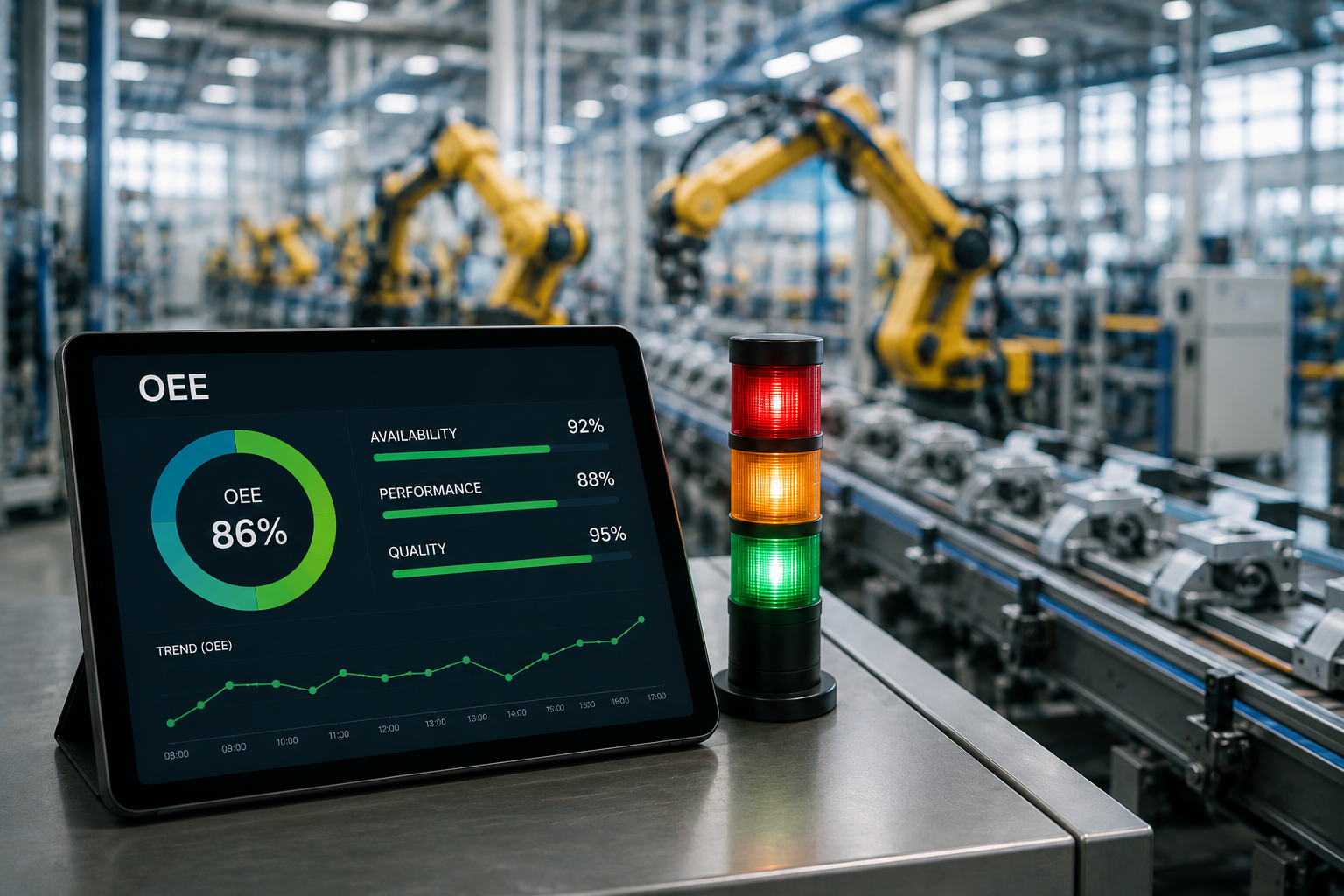
Overall Equipment Effectiveness (OEE) is a widely used performance indicator for evaluating how effectively manufacturing equipment contributes to production.
OEE is generally calculated from three key components:
- Availability — measures how much scheduled production time equipment is available for operation.
- Performance — evaluates production speed against the expected or ideal production rate.
- Quality — measures the proportion of output that meets the required quality standards.
These three elements provide a broader perspective on machine performance. Instead of looking at production output alone, manufacturing teams can understand how equipment availability, operating speed, and quality contribute to overall production effectiveness.
What Manufacturing Teams Should Monitor
A strong OEE monitoring process starts with collecting the operational information that influences production performance.
Depending on the manufacturing environment, teams can monitor:
- Machine operating status
- Production cycle time
- Production output
- Planned production time
- Actual operating time
- Downtime duration
- Downtime events and causes
- Machine utilization
- Good production output
- Defect or rejected output
- Production targets
- Historical machine performance
When these data points are connected, Production Managers can gain a more complete picture of machine performance across individual production lines or facilities.
How IoT Supports OEE Monitoring
IoT sensors and connected machines can continuously collect operational data directly from manufacturing equipment. This information can then be transmitted to a centralized platform for monitoring, analysis, and reporting.
An IoT-enabled OEE workflow can connect:
Machine Sensors → Industrial Connectivity → IoT Platform → OEE Analytics → Production Dashboard
Through this connected architecture, manufacturers can build a more responsive production monitoring environment.
IoT can help teams:
- Capture machine data automatically
- Monitor equipment status in real time
- Track production output
- Measure operating time
- Record downtime events
- Monitor production cycle times
- Calculate OEE indicators
- Analyze historical performance
- Compare production performance across machines or lines
- Create centralized production dashboards
The result is a more connected approach to understanding how manufacturing equipment contributes to daily production performance.
Using Real-Time Data to Understand Production Performance
Real-time data becomes particularly valuable when Production Managers need to understand what is happening across multiple machines or production lines.
For example, a manufacturing facility may operate several production lines with different equipment configurations. An Industrial IoT Platform can collect machine status, output, cycle time, and downtime information from each line.
A centralized dashboard can then provide visibility into metrics such as:
- OEE percentage
- Availability
- Performance
- Quality
- Production output
- Machine utilization
- Downtime duration
- Production trends
Managers can use these insights to identify which production lines are performing consistently and which areas have opportunities for further optimization.
Connecting OEE with Downtime Insights
Downtime is one of the important elements that influences equipment availability. IoT monitoring can provide additional context by connecting machine status with timestamps, production schedules, and operational events.
For example, when a machine changes from an operating state to an idle or stopped state, the IoT platform can record the event and its duration.
Over time, production teams can analyze patterns such as:
- Frequency of downtime events
- Average downtime duration
- Downtime by machine
- Downtime by production line
- Downtime trends by shift
- Recurring equipment conditions
- Production periods with the highest downtime
This information provides a useful foundation for maintenance planning, production scheduling, and continuous improvement initiatives.
Turning OEE Data into Continuous Improvement
OEE becomes more valuable when it is used as part of an ongoing improvement cycle.
Manufacturing teams can establish a process such as:
- Collect machine data from connected equipment.
- Monitor OEE metrics through centralized dashboards.
- Identify performance patterns across machines and production lines.
- Review contributing factors such as availability, performance, and quality.
- Implement operational improvements based on measurable findings.
- Monitor subsequent performance to evaluate the results.
This creates a data-driven improvement cycle where production teams can measure the impact of operational initiatives over time.
How an Industrial IoT Platform Supports OEE Management
An Industrial IoT Platform brings machine connectivity, data collection, analytics, and visualization into a centralized environment.
Depending on the manufacturing requirements, the platform can support:
- Real-time machine monitoring
- Automated machine data collection
- OEE calculation and monitoring
- Availability tracking
- Performance monitoring
- Quality performance tracking
- Downtime monitoring
- Production output tracking
- Historical trend analysis
- Multi-machine and multi-line dashboards
- Production KPI reporting
- Data integration with manufacturing systems
These capabilities give Manufacturing Directors and Production Managers a more comprehensive view of production performance while supporting faster and more informed operational decisions.
From Machine Data to Production Intelligence
The value of IoT in manufacturing extends beyond collecting information from machines. When machine data is structured into meaningful OEE metrics, production teams can understand how equipment performance influences broader operational outcomes.
For example, historical OEE data can help teams identify production trends across shifts, machines, or production lines. These insights can support discussions around production capacity, maintenance planning, equipment utilization, and continuous improvement priorities.
With the right analytics framework, machine data becomes a valuable source of production intelligence.
Building a More Connected Manufacturing Operation
Improving OEE starts with understanding how equipment performs across availability, performance, and quality. IoT technology strengthens this process by connecting machines with real-time data collection, centralized analytics, and operational dashboards.
For Manufacturing Directors and Production Managers, an Industrial IoT Platform provides a modern foundation for monitoring machine performance, understanding OEE trends, and supporting continuous production improvement.
By transforming machine data into measurable production insights, manufacturers can build a more connected, intelligent, and data-driven production environment that supports operational efficiency and long-term business performance.